


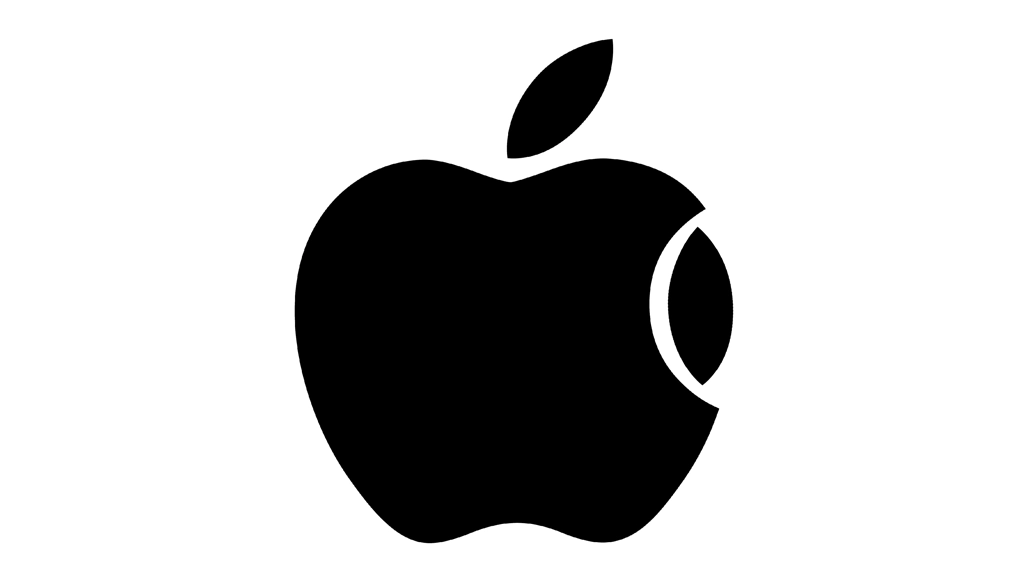
Every few months I see a post doing the rounds on LinkedIn or X insisting that the Apple logo is a masterclass in hidden geometry. The best one claims the little leaf slots perfectly into the bite mark. It’s a neat thought and it tickles the brain. But is it true? Short answer: no. It’s a lovely internet myth. The longer answer is far more interesting, and it says a lot about how great logos actually get made.
A quick origin story
Back in 1977, designer Rob Janoff created Apple’s bitten-fruit mark. The previous logo showed Isaac Newton under an apple tree. It was clever, but far too detailed to work on a product. Janoff’s brief was simple: make something bold, unmistakable and friendly that would still read on the side of a tiny computer. He drew an apple silhouette, took a bite out of it, and tilted a leaf to give it a bit of character.
Why the bite? Two pragmatic reasons that any designer will nod along to:
- It stops the shape reading as a cherry at small sizes.
- It adds a human, familiar moment. People bite apples. It’s relatable.
That’s it. No sacred geometry. No secret grid. No hour-long presentation about Fibonacci. A strong shape, a practical cut-out, and a jaunty leaf.
The myths that won’t die
Over time the logo picked up stories. The internet loves a conspiracy, and branding is fertile ground for it. Here are the big ones you’ll hear, and the reality.
Myth 1: It’s a byte pun
People love to say the bite is a tech gag about bytes. Fun coincidence, not the origin. The pun came after the mark existed. Designers are human – we appreciate a happy accident when it appears – but the bite was added for legibility, not wordplay.
Myth 2: It is a tribute to Alan Turing
This one’s romantic, and I understand why it sticks. Turing’s story is powerful. But both Apple and the designer have said it wasn’t an intentional homage. People can find meaning in symbols and that’s fine, but we should separate post-rationalised poetry from the design brief.
Myth 3: It follows the golden ratio
There are endless circle-packing overlays, perfect spirals and golden rectangles that supposedly reveal the logo’s divine maths. If you take enough circles and squish them around, you can make them touch any curve you fancy. That doesn’t mean the curve was built that way. Good designers use curves that feel right, not because a spreadsheet demands it.
Myth 4: The leaf fits into the bite
The star of today’s show. If you rotate and scale the leaf in some of those viral graphics, you can just about tuck it inside the bite. The problem is you have to rotate and scale the leaf. If two shapes were truly designed to interlock, you would not need to cheat the size or angle. When you overlay the actual forms, the radii and angles do not match. It is a cute meme, not a construction method.
Why the myth persists
There are a few reasons these ideas keep coming back.
First, great logos look inevitable. When something is so clean and self-assured, we assume there must be a hidden system behind it. Sometimes there is. Often there isn’t. The system is the designer’s eye.
Second, we love stories. A neat tale about a byte or a secret fit is more shareable than “the bite helped at small sizes”.
Third, social media rewards visuals you can grasp in a second. A mockup of the leaf snapping into the bite is satisfying in the way a jigsaw piece is satisfying. It feels right even when it is wrong.
What this teaches you about good logos
As a working designer who spends a lot of time helping Yorkshire businesses sharpen their brands, here is the real lesson I want clients to take from the Apple logo.
1) Clarity beats cleverness
Clever can be brilliant when it serves clarity. But if your clever idea gets in the way of someone recognising the mark in a split second, it is a tax on your brand. The Apple bite is clever precisely because it made the silhouette clearer. Function first, smile second.
2) A memorable silhouette does the heavy lifting
Most people encounter your logo small and far away – a favicon, a social avatar, a van livery driving past. If the outline is distinctive, you win. The Apple mark is memorable from twenty feet away, in one colour, on any background. That is the bar.
3) Grids and ratios are tools, not rules
I am not anti-grid. I use construction lines all the time. They help you stay consistent and avoid lumpy curves. But they are scaffolding, not the building. If the grid tells you something looks right while your eye screams that it doesn’t, trust your eye.
4) Meaning grows after launch
Designers and founders want every stroke to carry deep meaning on day one. Real people do not experience your work that way. They meet your logo in the wild, attach experiences to it, and the meaning grows. The rainbow stripes once spoke to approachability and to a screen that could show colour. Today, the same bitten apple – now monochrome – speaks to premium craft, privacy, and a whole ecosystem. Meaning is a relationship, not a riddle hidden in the artwork.
The journey of the mark is part of the magic
Another reason the Apple logo fascinates people is that it has evolved without losing its soul. The silhouette has stayed consistent while treatments have changed – rainbow, glossy aqua, flat, muted metal, backlit. That is the sign of a robust core asset. When a logo has a strong skeleton, you can dress it for any era and it still feels like itself.
For smaller brands, this is a huge practical advantage. It means you can adapt the way your mark shows up on packaging, signage and digital without restarting your brand recognition every five years. If the bones are good, you have options.
How to apply these lessons to your own logo
If you are a founder, marketing manager or local business owner looking at your current mark and wondering whether it will hold up, use this quick checklist I give my clients.
1) Does it work in one colour at 16px?
If it falls apart as a favicon or on a black and white invoice, it is not there yet.
2) Could a child draw the outline from memory?
If the silhouette is complicated, you will spend a fortune on reminding people who you are.
3) Does it still feel like you when stripped of effects?
Gradients and textures are seasonal. Your core shape is the evergreen bit.
4) Does it look like anyone else in your category?
Differentiation is not a luxury. It is the point.
5) Is there a simple, honest story behind it?
Not a myth. A sentence. Why it looks the way it does, in language a customer would understand.
A designer’s confession about myths
Here’s the honest bit from someone who designs identities for a living in Leeds and beyond. Do I occasionally retro-explain a curve or a corner with a tidy sentence in a brand deck? Of course. Storytelling is part of the job. But the story must never be a fig leaf for poor decisions. The right line weight, the right counter space, the right negative shape – these are mostly about looking, adjusting, and testing in context until it clicks.
The Apple logo clicked because it was drawn with the end use in mind. It needed to read as an apple on a beige computer case in 1977. It still reads as an apple on a watch in 2025. That is success.
So, does the leaf fit the bite?
No. Not without a bit of cheating. And it does not need to. The logo endures because the whole is greater than the sum of its parts. The bite gives you recognition. The leaf gives you character. The silhouette gives you power. Everything else is noise.
If you are planning a rebrand or a new logo
If this myth has you looking a bit harder at your own mark, that is a good thing. Use it as a nudge to ask better questions:
- What problem is our logo solving?
- Where does it most often need to work?
- What shapes genuinely belong to our brand, versus what is fashionable this year?
- Does our symbol carry through consistently from social avatars to vans to invoices to app icons?
If you want a second pair of eyes, I can help. I work hands-on with business owners to create simple, distinctive identities that behave well in the real world. No sacred geometry. No jargon. Just a mark you can be proud of that your customers will actually recognise.
The internet will keep inventing neat stories about famous logos because it is fun. And that is fine. But the best story your brand can tell is the one your customers recognise at a glance when they scroll past at speed or spot your van at the lights. The Apple logo reminds us that focus and restraint beat secret tricks every time.
If you would like me to audit your current logo or sketch a handful of strong directions for a refresh, drop me a message. Let’s make something clear, memorable and yours.